
DTF vs Screen Printing: Which Printing Method Is Right for Your Apparel Project?
Key Takeaways
- DTF printing is usually the better choice for small orders and complex, full-color artwork.
- Screen printing becomes more economical as production volume increases.
- Both methods can produce durable prints when proper materials and curing processes are used.
- Artwork complexity, garment type, and reorder plans often influence the best printing method more than price alone.
- Many apparel manufacturers use both technologies depending on each project's production requirements.
| Criteria | DTF | Screen Printing |
| Small Orders | ⭐⭐⭐⭐⭐ | ⭐⭐ |
| Bulk Production | ⭐⭐ | ⭐⭐⭐⭐⭐ |
| Fine Detail | ⭐⭐⭐⭐⭐ | ⭐⭐⭐ |
| Solid Colors | ⭐⭐⭐⭐ | ⭐⭐⭐⭐⭐ |
| Cost Efficiency (Large Orders) | ⭐⭐ | ⭐⭐⭐⭐⭐ |
| Fabric Compatibility | ⭐⭐⭐⭐ | ⭐⭐⭐⭐ |
Quick Comparison Table
| Factor | DTF Printing | Screen Printing |
| Best For | Small orders & complex artwork | Large production runs |
| Setup Cost | Low | Medium High (screen preparation required) |
| Cost Per Piece | Consistent regardless of quantity | Drops significantly on large orders |
| Artwork Complexity | Unlimited colors and fine details | Best for simple graphics |
| Color Accuracy | Excellent photographic reproduction | Excellent solid color consistency |
| Fabric Compatibility | Cotton, polyester, blends, fleece, nylon | Works on most fabrics using different ink systems |
| Production Speed | Fast for short runs | Extremely fast for bulk orders |
| Durability | Very good when properly applied | Excellent |
| MOQ Suitability | Low MOQ | Better for medium to large MOQ |
| Ideal Buyers | Startup brands, samples, limited editions | Established brands, promotional apparel, and uniforms |
Table of Contents
- What Is DTF Printing?
- What Is Screen Printing?
- Which Costs Less?
- Which Lasts Longer?
- Which Looks Better?
- Which Works on More Fabrics?
- Which Is Better for Small Orders?
- Which Is Better for Bulk Production?
- DTF or Screen Printing for Startup Brands?
- Pros and Cons
- Decision Matrix
- Common Buyer Mistakes
- Final Recommendation
- FAQ
Introduction
Choosing between DTF printing and screen printing is one of the most common decisions apparel brands face when planning custom T-shirts, hoodies, sportswear, uniforms, or promotional clothing. Both methods are widely used in commercial garment manufacturing, yet they differ significantly in production workflow, cost structure, artwork flexibility, and scalability. If you're new to garment decoration, understanding the different types of shirt printing methods can make it easier to compare these two techniques.
Many online comparisons focus only on print quality or durability. In reality, manufacturers evaluate several additional factors before recommending a printing method, including setup requirements, production efficiency, order quantity, fabric composition, artwork complexity, and the likelihood of future reorders.
This guide compares DTF vs screen printing from a manufacturing perspective to help clothing brands, purchasing managers, and startup businesses choose the most suitable solution for their specific production goals. It also reflects how these decoration methods fit into the overall custom apparel manufacturing process, from sampling to bulk production.
What Is DTF Printing?

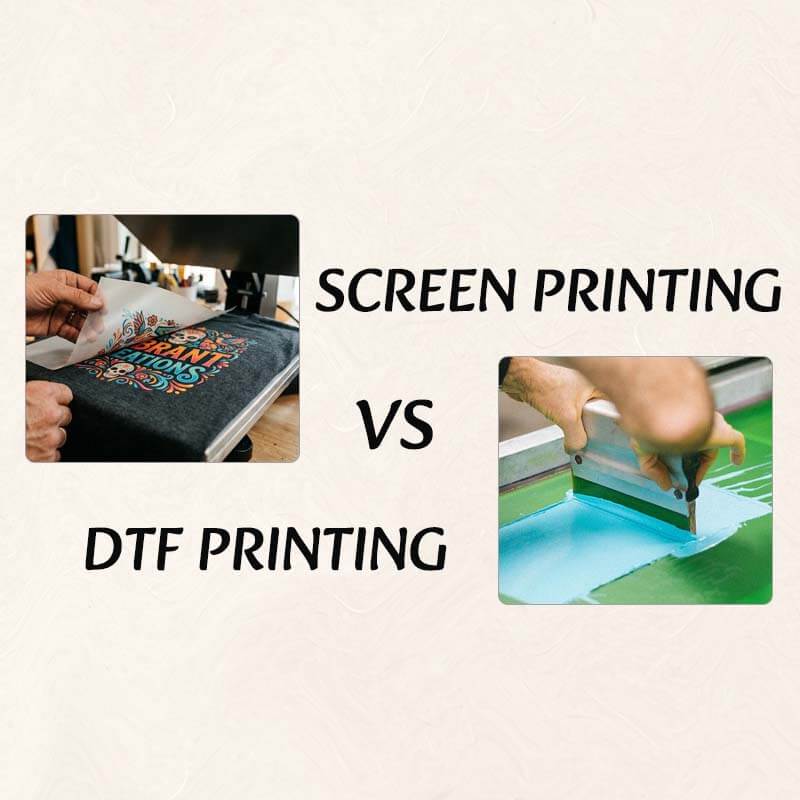
DTF is one of the fastest-growing digital garment printing technologies. DTF (Direct-to-Film) printing is a digital decoration process in which artwork is printed onto a special transfer film using CMYK and white inks. Adhesive powder is then applied to the printed design before it is cured and transferred onto the garment using a heat press.
Unlike traditional screen printing, DTF requires no screens or color separations. Each design can be printed individually, making it particularly suitable for personalized apparel, low-volume production, and artwork containing gradients, photographs, or numerous colors.
Because setup is minimal, manufacturers can switch between different designs quickly without interrupting production. This flexibility has made DTF increasingly popular for startup clothing brands, print-on-demand businesses, event merchandise, and product sampling.
Typical Applications
- Fashion brands testing new collections
- Small-batch apparel manufacturing
- Promotional clothing with multiple designs
- Sportswear and team apparel
- Complex artwork with gradients or photo-quality images
- Personalized garments with names or numbers
Manufacturer Insight
From a production standpoint, DTF significantly reduces preparation time because no screens need to be produced. This allows manufacturers to accommodate frequent artwork changes efficiently, making it an excellent option for brands that launch seasonal collections or regularly introduce new graphics.
What Is Screen Printing?
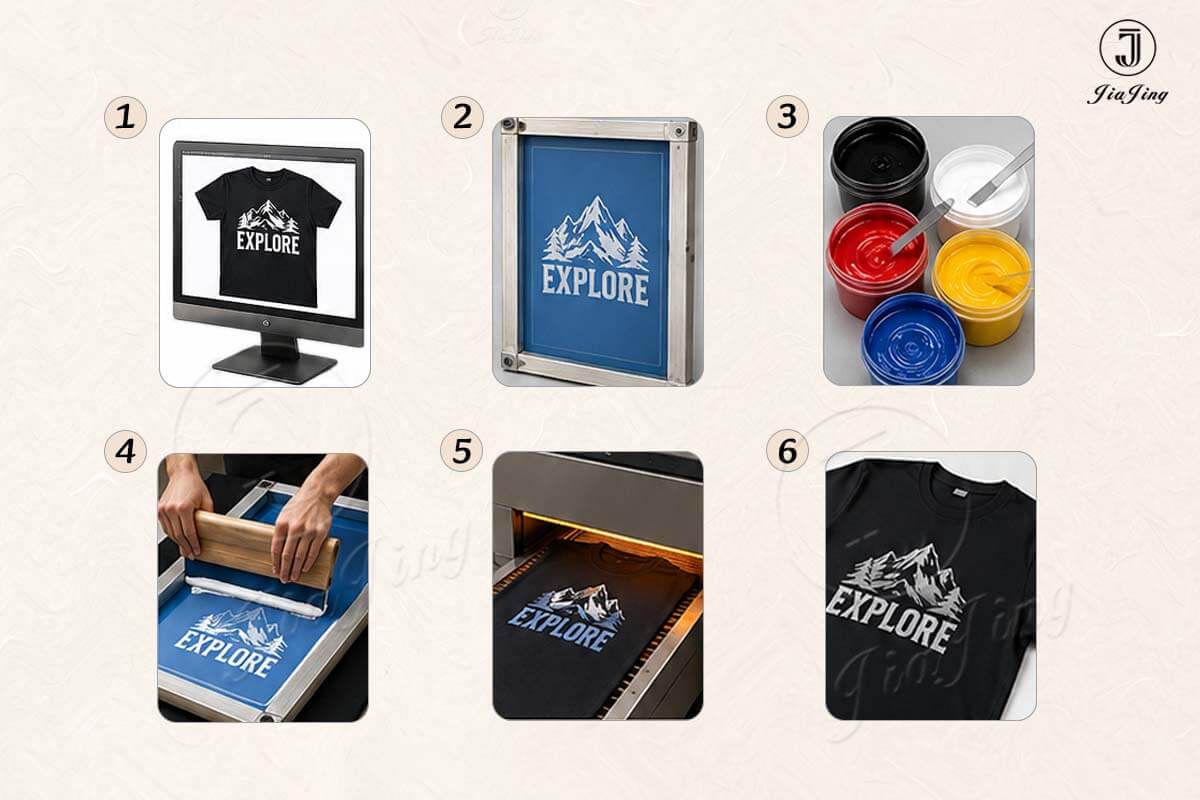
Screen printing, also known as silk screen printing, is a traditional printing technique that transfers ink onto fabric through mesh screens. Each color in the design requires its own screen, and every screen must be accurately aligned before production begins.
Although screen preparation increases initial setup time and cost, the printing process becomes extremely efficient once production starts. As order quantities increase, the setup cost is spread across more garments, significantly reducing the cost per piece. This production efficiency has made screen printing one of the most widely used shirt printing methods for retail brands, promotional apparel, and corporate uniforms.
This efficiency has made screen printing the industry standard for large production runs, company uniforms, promotional apparel, retail merchandise, and many fashion brands producing consistent designs at scale.
Typical Applications
- Bulk T-shirt production
- Corporate uniforms
- School apparel
- Promotional merchandise
- Retail fashion collections
- Simple logos and bold graphics
Manufacturer Insight
During commercial apparel manufacturing, screen printing remains one of the most productive decoration methods for repeat orders. Once screens have been prepared, manufacturers can reproduce the same artwork with excellent consistency across hundreds or even thousands of garments.
Which costs Less, DTF or screen printing?
The answer depends primarily on order quantity, not simply the printing method itself.
DTF printing requires almost no setup, meaning the production cost for one shirt and fifty shirts remains relatively consistent. Screen printing, however, involves screen creation, color separation, registration, and press setup before the first garment is printed.
For small orders, those setup costs represent a significant portion of the total production cost, making DTF the more economical choice in many situations.
As production volume increases, screen printing becomes increasingly cost-effective because the initial setup expense is distributed across every garment. Eventually, its unit cost becomes substantially lower than DTF for large production runs.
| Production Scenario | Recommended Method | Reason |
| 1–50 garments | DTF Printing | Minimal setup cost and fast turnaround |
| 50–200 garments | Depends on artwork complexity | Evaluate colors and design changes |
| 200+ garments | Screen Printing | Lower cost per garment after setup |
| Frequent artwork changes | DTF Printing | No need to remake screens |
| Repeat bulk orders | Screen Printing | Excellent production efficiency |
Buyer Tip
When requesting quotations, ask manufacturers to compare both printing methods using your actual artwork and estimated order quantity. The most economical option often changes depending on the number of print colors, garment style, and expected reorder frequency.
Which Lasts Longer, DTF or Screen printing?
Both DTF printing and screen printing can deliver excellent durability when high-quality materials, proper curing temperatures, and correct application techniques are used.
Screen printing has built its reputation over decades for producing highly durable prints that withstand repeated washing. Plastisol and water-based inks penetrate or bond effectively with fabric, making them especially suitable for workwear, uniforms, and frequently worn garments.
Modern DTF technology has improved significantly in recent years. High-quality transfer films and adhesives now produce flexible prints with strong wash resistance, provided garments are washed and cared for according to recommended instructions. The print stretches well on many knit fabrics while maintaining color vibrancy.
Rather than asking which method lasts longer in every situation, buyers should evaluate whether the manufacturer follows proper curing, heat pressing, and quality inspection procedures, as these production variables often have a greater impact on durability than the printing method itself.
Which Looks Better?
Neither printing method is universally better in appearance. The visual result depends on the artwork style, garment fabric, and the look you want to achieve.
DTF printing excels at reproducing highly detailed graphics, gradients, shadows, and photographic images. Because the artwork is printed digitally, there are virtually no color limitations, making it ideal for modern streetwear graphics, illustrations, and multicolor logos.
Screen printing, however, is well known for its bold, vibrant solid colors and clean edges. Specialty inks such as puff, metallic, glitter, high-density, discharge, and water-based inks also provide unique textures and finishes that are difficult or impossible to achieve with standard DTF transfers.
| Artwork Type | Better Choice | Why |
| Photographs | DTF Printing | Excellent color gradients and fine detail |
| Complex illustrations | DTF Printing | Unlimited colors without additional setup |
| Simple logos | Screen Printing | Sharp edges and vibrant solid colors |
| Vintage fashion effects | Screen Printing | Supports discharge and specialty inks |
| Oversized fashion graphics | Depends on production goals | Both methods can perform well |
Manufacturer Insight
Artwork preparation often determines print quality more than the printing technology itself. High-resolution artwork, correct color profiles, and properly prepared vector files help both DTF and screen printing achieve better commercial results.
If you're also deciding between printed graphics and stitched logos, our comparison of printing vs embroidery explains the strengths and limitations of each decoration method for different apparel projects.
Which Works on More Fabrics?
Both printing methods are compatible with a wide variety of fabrics, but they achieve this in different ways.
DTF printing is highly versatile because the transfer is applied after printing. It performs well on cotton, polyester, cotton-poly blends, fleece, canvas, and many performance fabrics without requiring different printing equipment for each material.
Screen printing can also decorate nearly every apparel fabric, but manufacturers often select different ink systems depending on the garment. Plastisol inks, water-based inks, discharge inks, and specialty formulations are chosen according to fiber composition and desired appearance.
| Fabric | DTF Printing | Screen Printing |
| 100% Cotton | Excellent | Excellent |
| Polyester | Excellent | Excellent (appropriate inks required) |
| Cotton Blends | Excellent | Excellent |
| Fleece | Very Good | Excellent |
| Performance Fabrics | Very Good | Very Good |
| Nylon | Good (special film may be required) | Good (special inks may be required) |
Buyer Tip
Always confirm the fabric composition before selecting a printing method. The same artwork may produce different results on lightweight cotton, heavyweight fleece, or moisture-wicking polyester, even when using the same decoration technology.
Fabric selection is especially important for custom sportswear manufacturing, where stretch performance, moisture management, and print durability all influence the best decoration method.
Which Is Better for Small Orders?
For most small production runs, DTF printing is the clear winner.
Because it requires almost no setup, manufacturers can efficiently produce as few as one garment or several dozen garments without incurring significant preparation costs. This makes DTF especially attractive for startup brands, product testing, influencer merchandise, event apparel, and personalized clothing.
Another advantage is production flexibility. Each garment can feature different artwork without slowing the workflow, allowing brands to launch multiple designs in a single production batch.
Best Small-Order Scenarios
- Startup clothing brands
- New product launches
- Limited-edition collections
- Artist collaborations
- Corporate samples
- Personalized apparel
Production Scenario
During sample development, manufacturers often recommend DTF because design revisions are common. Producing new screens after every artwork change would increase both cost and lead time, whereas DTF allows quick adjustments without restarting the production process. Many startup brands combine DTF printing with small-batch clothing manufacturing to test new collections before investing in large production runs.
Which Is Better for Bulk Production?

When production volume increases into the hundreds or thousands of garments, screen printing usually offers the greatest manufacturing efficiency.
Although preparing screens requires additional labor before production begins, the printing process itself is extremely fast. Once the press is running, manufacturers can print large quantities with excellent consistency and lower unit costs.
Screen printing also simplifies repeat orders. If the artwork remains unchanged, existing production files and screen specifications can often be reused, improving efficiency for future manufacturing runs.
Best Bulk Production Scenarios
- Retail clothing collections
- Corporate uniforms
- School apparel
- Sports team merchandise
- Promotional campaigns
- National retail programs
Lead Time Consideration
Although screen printing requires additional setup during pre-production, its high printing speed frequently shortens the overall production schedule for large orders compared with digital decoration methods.
Brands preparing for seasonal launches often pair screen printing with an experienced OEM clothing manufacturer to ensure consistent quality and on-time delivery across large production runs.
DTF or Screen Printing for Startup Brands?
Startup brands often prioritize flexibility over maximum production efficiency, making DTF an excellent choice during the early stages of business growth.
Launching a new clothing brand usually involves testing multiple graphics, experimenting with different garment styles, and validating customer demand. Since DTF accommodates frequent design changes without additional setup, it reduces financial risk during this phase.
As sales become more predictable and order quantities increase, many brands gradually transition popular designs to screen printing to reduce long-term production costs.
| Business Stage | Recommended Method | Main Reason |
| Startup Brand | DTF Printing | Flexibility and low setup cost |
| Growing Brand | Combination of Both | Optimize each design individually |
| Established Brand | Screen Printing | Large production efficiency |
Manufacturer Insight
Many OEM clothing manufacturers do not view DTF and screen printing as competing technologies. Instead, they select the most appropriate method for each production order based on artwork, quantity, delivery schedule, and customer objectives.
Pros and Cons
| DTF Printing | Screen Printing |
|
Advantages
|
Advantages
|
|
Limitations
|
Limitations
|
Common Buyer Mistakes
- Choosing based only on unit price. Setup costs, reorder plans, and production efficiency often have a greater impact on total manufacturing cost.
- Ignoring artwork complexity. Highly detailed graphics may significantly increase screen printing preparation time.
- Selecting a method before confirming fabric type. Different fabrics may require different inks, films, or application processes.
- Overlooking future reorders. A decoration method that is ideal for samples may not be the most economical solution for future bulk production.
- Comparing technologies instead of production goals. The best printing method is the one that supports your business objectives, not necessarily the newest technology.
How We Recommend Printing Methods
There is no universal winner in the DTF vs screen printing debate because each technology is designed for different production requirements.
If your project involves small quantities, multiple designs, or highly detailed artwork, DTF printing generally provides the greatest flexibility and fastest turnaround. If your goal is to produce hundreds or thousands of garments with consistent graphics and the lowest long-term unit cost, screen printing remains the industry standard.
If your next project involves custom T-shirts, hoodies, or activewear, reviewing our custom T-shirt manufacturing capabilities can help you understand the available printing and production options before requesting a quotation.
From a manufacturer's perspective, the most successful apparel projects begin by evaluating artwork, garment type, order quantity, delivery schedule, and future reorder plans together rather than selecting a printing method based on only one factor.
If you're planning a custom apparel project, discussing these production requirements with an experienced clothing manufacturer can help you choose the decoration method that best balances quality, efficiency, and cost.
Frequently Asked Questions
DTF vs DTG Printing: Which Printing Method Is Right for Your Apparel Project?
$50 vs $500 Hawaiian Shirt: A Factory Reveals the Real Difference


Launch Your Precision Manufacturing Project