
$50 vs $500 Hawaiian Shirt: A Factory Reveals the Real Difference
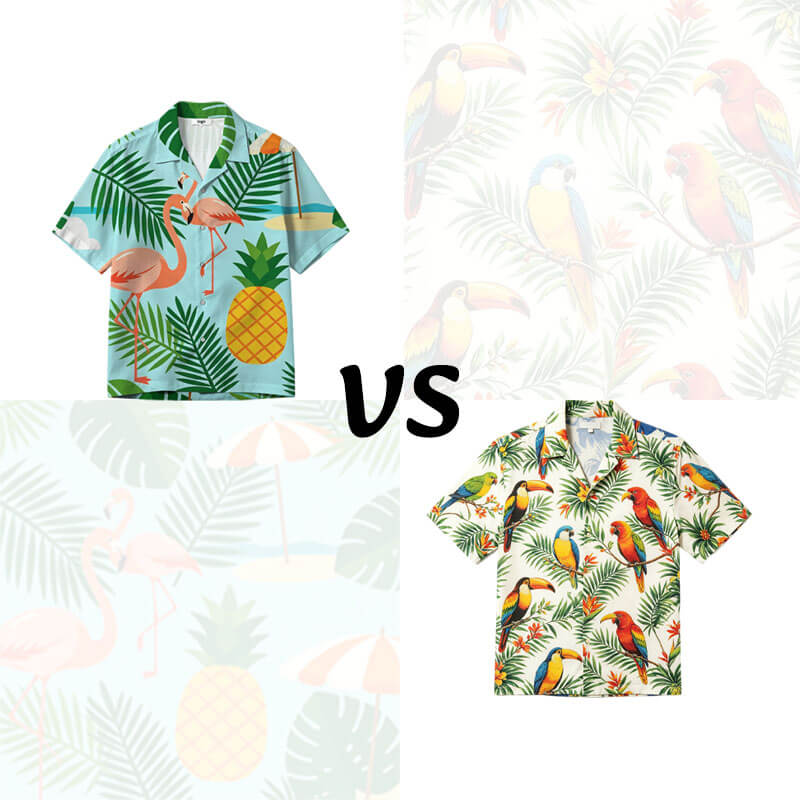
Have you ever searched for "custom Hawaiian shirt" on Alibaba International and seen options at $50 and $500? The product images look almost the same. So you choose the cheap one.
Then what happens? The print doesn't align – the pattern breaks at the placket. After one wash, the collar becomes as soft as a rag. After half a day, the armpit seam bursts. Your customers return the shirts, and your brand reputation suffers.
Many customers will ask the same question: "Why should I pay you more than those small workshops?"
Today I will show you directly from our workshop – machines, stitch density, interlining – what really separates a $500 shirt from a $50 one. If you are a brand owner, event agency, or wholesaler, this article is worth reading and bookmarking.
According to Google Trends data (Apr 2025 – Apr 2026), searches for "Hawaiian shirt" increased 42% YoY, with B2B terms (wholesale, custom, bulk) growing 65%.
1. Print Alignment: High-end Uses Digital Rotary Screen – Low end Still Uses Hand-Operated Flat Screen
$50 tier: Mostly flat screen printing or even manual table printing. Each color is aligned by hand, with an error of ±3mm or more. The result: left and right sides of the placket don’t match, and the pattern at the side seam looks cut off.
$500 tier: Uses digital rotary screen printing machines. The machine automatically aligns patterns via an electric eye, with an error of less than 0.5mm. When laid flat, the print is continuous and complete – like wearing a canvas. Industry standards require high-end garment print alignment error to be ≤0.5mm.

2. Fabric: Viscose vs 100% Polyester
$50 shirt: Almost always 100% polyester. Not breathable – wearing it in summer feels like a plastic bag. It starts pilling after two washes and has serious static issues.
$500 shirt: Cotton or bamboo fiber. They drape beautifully, absorb moisture and breathe well. The hand feel is close to silk, with minimal shrinkage (<3%) and high color fastness (≥ grade 4). High-quality viscose with reactive dyes can consistently achieve grade 4 or above.

3. Sewing Standard: 18 Stitches per 3cm vs 12 Stitches
$50 shirt: Uses old sewing machines with loose stitch density – about 12 stitches per 3cm. The seams are slack; you can see gaps when you pull lightly. After half a day, the armpit or side seam often bursts.
$500 shirt: Uses Juki or Brother industrial machines. Standard is 18 stitches per 3cm. The stitches are tight and even, and they pass tensile tests. A shirt can be worn for two seasons without any seam issues. International sewing standards recommend 18-22 stitches/3cm for high-quality shirts.

4. Interlining: Woven vs Non-woven (Key to a Crisp Collar)
The collar’s shape depends on the interlining.
$50 shirt: Uses non-woven interlining – a paper-like sheet. It wrinkles and bubbles after one wash, and the collar becomes limp.
$500 shirt: Uses Freudenberg (Freudenberg Performance Materials) woven interlining. It is truly woven fabric – water-resistant, crisp, and resilient. Woven interlining withstands over 50 washes, while non-woven typically fails within 10 washes. The collar stays three-dimensional even after ten washes.

5. Buttons & Details: Coconut Buttons vs Plastic Buttons
$50 shirt: Plastic buttons with a cheap shine that crack easily when dropped.
$500 shirt: Coconut shell, mother-of-pearl, or corozo buttons. Each button has natural texture, and we can laser-engrave your brand logo on them. We also add a woven label at the back collar with your brand name – the first thing customers see when they open the package.
In addition, premium shirts include three-color piping and felled side seams. You won’t find these details at the $50 price point.

6. Quality Control: 100% Inspection + Shrinkage Test vs Spot Check
$50 workshop: Spot check or no inspection at all. Shrinkage can be 8-10%. After one wash, the shirt shrinks two sizes.
$500 factory: 100% inspection. Every fabric batch is pre-tested for shrinkage, which we keep under 3%. Color fastness and rubbing fastness are all grade 4 or above. High-quality garments should have shrinkage within 3%.
7. As a B2B Buyer, How Should You Choose?
The $50 tier is for: one-time events, photo props, no quality requirements, high return rate acceptable.
The $500 tier is for: brand retail, corporate gifts, repeat orders, return rate below 1%, building reputation.
Our suggestion: start with a sample run. We support small orders of 50-100 pieces so you can see and feel the actual product. The sample fee is refundable on the bulk order. According to industry research, low-end apparel can have return rates above 10%, while premium brands with strict QC can keep returns below 3% (Forrester Research).
8. What Can Our Factory Do for You?
Instead of fast food fashion concept, vetiver is based on the idea of the wearer, not limited to the scope of age or season. At every time of the day, every region and every place can freely change and connect smoothly. Vetiver skillfully combines leisure style and soft multi-functional materials to create a clothing piece valued by fearless and confident women.
✅ In-stock fabrics: Viscose / Bamboo / Tencel – ready inventory
✅ Digital + rotary screen printing, MOQ from 50 pieces
✅ Free sample making (upon discussion)
✅ Lead time: sample 7-15 days, bulk 25-35 days
✅ 100% inspection, shrinkage < 3%
Click here to get a custom Hawaiian shirt quotation + fabric swatch card
DTF vs Screen Printing: Which Printing Method Is Right for Your Apparel Project?
Different Types of Dresses Ultimate Guide: B2B Custom Factory Sourcing (2026 Trends)


Launch Your Precision Manufacturing Project